

Cloud brokerages are no longer a fringe idea — they’re at the center of the real estate industry’s evolution. Agents today expect lower costs, advanced technology, and multiple streams of income beyond commission.
Brokerages that fail to innovate are losing ground to companies like REAL and LPT Realty, which are both growing rapidly by offering modern alternatives to the traditional franchise model.
At first glance, the two companies seem similar. Both are cloud-based, both tout revenue share programs, and both claim to put agents first. But a closer look at REAL vs LPT Realty reveals clear differences in philosophy, structure, and opportunity.
REAL is a technology-first brokerage, employing over 130 full-time staff dedicated to building proprietary platforms, AI tools, and fintech integrations.
With products like reZEN, Real Wallet, and the AI-powered Leo CoPilot, REAL is betting on technology as the key to scaling agent success.
LPT Realty, meanwhile, has leaned into affordability as its competitive advantage. Marketed as the cheapest cloud brokerage option, LPT appeals to cost-conscious agents by removing monthly fees and offering two different business plans.
Agents can choose the Business Builder Plan, which charges a flat per-transaction fee, or the Brokerage Partner Plan, which uses a traditional split with a cap. This flexibility allows agents to pick the structure that best matches their production style and financial goals.
Both models are attractive, but they’re not interchangeable. Let’s dive into the details.
REAL vs LPT Realty Company Background
REAL
Founded in 2014 by CEO Tamir Poleg, REAL is now one of the fastest-growing brokerages in North America. The company is publicly traded on the NASDAQ (REAX) and has surpassed 30,000 agents across the U.S. and Canada as of mid-2025 (REAL Investor Relations).
REAL’s workforce includes more than 130 full-time employees working in engineering, product design, finance, compliance, and operations. Unlike brokerages that rely on third-party systems, REAL builds and owns much of its technology stack. This strategy has produced innovations such as:
reZEN: a proprietary back-office and transaction management platform.
Real Wallet: a financial hub with business checking, tax planning accounts, debit card, and a rewards program.
Leo CoPilot: an AI assistant that helps agents with tasks like drafting listing descriptions and managing workflows.
By integrating technology, finance, and brokerage operations, REAL aims to position itself as a one-stop platform for real estate professionals.
LPT Realty
LPT Realty is much newer, founded in 2022 by Robert Palmer as an expansion of his Listing Power Tools company, which focuses on print marketing for listings. The company is not publicly traded and does not disclose detailed financials, but it markets itself heavily as the most affordable option among cloud brokerages.
LPT’s standout feature is its two-plan system. Agents can choose between:
Business Builder Plan: $500 per transaction with a $5,000 annual cap.
Brokerage Partner Plan: 80/20 split with a $15,000 cap.
This dual model allows agents to pick whichever plan best suits their production level. The Business Builder Plan works well for agents who value predictable, low fees, while the RevShare Partner Plan is more similar to those who prefer a percentage-based structure. For agents to start a team, receive revenue share, or receive the top production stock awards, they need to be in the Rev Share Partner plan.
In addition to low costs, LPT offers agents access to marketing support through its Collateral Marketing System, CRM, IDX website, and document tools. It also recently introduced dezzy.ai, an AI assistant for creating marketing content. While these features are valuable, most are provided through third-party integrations rather than proprietary development.
REAL vs LPT Realty Commission Splits, Caps, and Fees
When evaluating a brokerage, commission splits, caps, and fees are often the first things agents compare. Both REAL and LPT Realty offer competitive structures, but they approach costs differently.
REAL’s Splits, Cap & Fees
REAL agents operate under 85/15 split until they hit their cap. For most solo agents and team leaders, the cap is $12,000 annually. For team members, the cap is $6,000 or $4,000 for mega teams, one of the lowest available in the industry. Once capped, agents keep 100% of their commissions, paying only fixed transaction fees.
Fees at REAL include:
$900 annual fee (taken out of your first 3 transactions, $300 each)
$50 per transaction compliance fee.
$285 post-cap transaction fee, which drops to $100 per transaction after hitting Elite Agent.
This structure favors productive agents and teams. Hitting the cap quickly allows top performers to maximize take-home pay. The reduced $6,000 cap for team members is particularly attractive for teams looking to scale.
With the introduction of the REAL Wallet and its reward program, agents can lower these costs even further by using REAL’s debit card, tax savings account, or line of credit. This program could lower agents’ cost to the company by thousands a year.
LPT Realty’s Splits, Cap & Fees
LPT gives agents two paths. Under the Business Builder Plan, agents pay a flat $500 per transaction until they hit a $5,000 cap. Under the Brokerage Partner Plan, agents work on an 80/20 split with a $15,000 cap.
For both paths, agents also pay:
$500 annual fee, deducted from the first transaction each year.
$195 transaction fee.
This makes LPT attractive for agents who want some of the benefits of working at a cloud brokerage but are looking for the cheapest option. The absence of monthly fees reduces overhead, which is appealing for agents who may not close transactions every month. However, the higher $15,000 cap under the Brokerage Partner Plan can mean paying more company dollars overall compared to REAL’s $12,000 cap.
Key Differences
REAL’s structure is built for scalability and team growth, while LPT’s structure is built for affordability. REAL’s reduced cap for team members and technology investments makes it compelling for productive agents and teams. LPT’s flat fee model makes it the cheapest option for those seeking predictable, low costs.
REAL vs LPT Realty Revenue Share Opportunities
Both REAL and LPT Realty use revenue share as a way to reward agents for helping the brokerage grow. While both models can provide an additional income stream, the details of how revenue share is earned — and how much flexibility agents have in unlocking it — are very different.
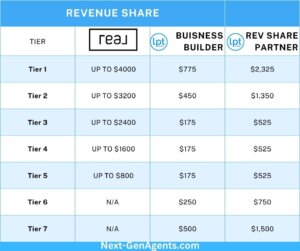
REAL’s Revenue Share Model
REAL pays out up to 60% of monthly revenue through its revenue share program to agents. Agents can unlock up to five tiers, each representing a level of downline agents. What makes REAL unique is the multiple ways to unlock those tiers:
- Tier 1 Agents: Similar to other cloud brokerages, you can unlock tiers of revenue share by having producing agents in your Tier 1.
- Unlock tier 2 with 5
- Unlock tier 3 with 15
- Unlock tier 4 with 20
- Unlock tier 5 with 25.
Production-based unlocks: Agents who hit a Full Cap automatically unlock Tiers 1–3 until their next anniversary. Agents who achieve Elite Agent status unlock all the way through Tier 5.
Attraction-based unlocks: Agents can also unlock tiers by growing their network.
750 agents to unlock Tiers 1–3
1,000 agents to unlock Tiers 1–4
1,500 agents to unlock Tiers 1–5.
This triple approach means agents are not limited to recruiting in order to grow their revenue share potential. High producers can earn more even if they are not focused on building a large downline. For team leaders who do both — producing and attracting — the system provides multiple pathways to maximize revenue share.
REAL not only pays out more of its monthly revenue, 60% vs 50%, it also pays out the most per agent out of any cloud brokerage. These numbers are the maximum you could earn per caping agent if you have the tier unlocked.
- Tier 1 – $4,000
- Tier 2 – $3,200
- Tier 3 – $2,400
- Tier 4 – $1,600
- Tier 5 – $800
Something unique about REAL’s revenue share program is that it offers co-sponsorship. This allows an agent to list 2 sponsors when joining the company. By doing this, the joining agent will have 2 uplines to lean on for support, and both co-sponsors will split the revenue share 50/50.
LPT Realty’s Revenue Share Model
LPT Realty distributes 50% of the company’s dollar into a seven-tier revenue share pool. While this offers more levels than REAL, there are several important restrictions.
- Agents in the flat fee Business Builder model are not eligible to receive revenue share. Only agents in the more expensive RevShare Partner program are.
Agents must pay their full $15,000 cap before they can receive revenue share. If they have not capped yet, any revenue share will be applied to the cap first.
Agents unlock tiers of revenue share by having “Active Direct Sponsored Agents” in their tier 1.
- Tier 1 – 1 agent
- Tier 2 – 3 agents
- Tier 3 – 5 agents
- Tier 4 – 7 agents
- Tier 5 – 9 agents
- Tier 6 – 14 agents
- Tier 7 – 15 agents
How much revenue share an agent can earn is dependent on which program the sponsor is in, Business Builder of Rev Share Partner. Some estimates say that over 90% of the company is in the Business Builder plan. Below is the maximum you can earn from a capping agent.
- Tier 1 – Business Builder: $775 Rev Share Partner $2,325
- Tier 2 – Business Builder: $450 Rev Share Partner $1,350
- Tier 3 – Business Builder: $175 Rev Share Partner $525
- Tier 4 – Business Builder: $175 Rev Share Partner $525
- Tier 5 – Business Builder: $175 Rev Share Partner $525
- Tier 6 – Business Builder: $250 Rev Share Partner $750
- Tier 7 – Business Builder: $500 Rev Share Partner $1,500
This structure emphasizes production first and delays the benefits of attraction. While unlocking tiers of revenue share may be easier for some, the trade-off is LPT pays significantly less per capping agent than REAL.
(Source)
Key Differences
REAL’s model offers flexibility in how you unlock your tiers, whether you want to do this by focusing on production or attraction. While in contrast, LPT model requires fewer tier 1 agents to unlock additional tiers of revenue share and offer 2 additional tiers.
There is also a major difference in how much the two models pay out. REAL pays out the most revenue share per agent and the most as a % of their monthly revenue, then any other cloud brokerage. While LPT pays out the least in revenue share out of any cloud brokerage, and because that money goes to paying your cap first, someone focused on attraction will be at a negative $15,000 advantage from the start.
For agents looking to integrate attraction into their business from the start, REAL’s model provides a faster path to earning revenue share.
REAL vs LPT Realty Stock Awards
Both companies award stock to their agents for hitting certain production milestones; however, REAL is publicly traded on the NASDAQ (REAX), and agents are able to sell their stock on the open market, while LPT is not publicly traded yet, and the value of the stock awarded is unknown at this time.
REAL’s Stock Program
REAL sees its stock awards to agents as an additional stream of income for their businesses. Because of this, they provide 4 different ways agents can earn free stock in the company each year.
- Capping – Currently, agents can earn 15 shares of stock each year for capping (7 for team members, 5 for mega-team members).
Sponsoring – When an agent you sponsor closes their first transaction, you earn 7 shares (3 for team members, 2 for mega-team members)
Elite Agent – Top-producing agents who qualify for Elite status can receive $12,000 in stock for the Production Awards, plus $8,000 in stock for the separate Cultural Award annually.
Stock Purchase Plan – Agents can purchase stock directly out of their commission and earn a 10% match before you cap and a 15% match after you cap.
Because of how much free stock you can earn at REAL, there are many agents who hit Elite Agent and earn more in free stock each year than they spend in fees and their cap to be an agent at REAL. This means REAL is effectively paying them to be agents here. Use my free REAL Fee Calculator to see how many deals a year you would need to hit Elite Agent.
Because REAL stock is publicly listed, agents have immediate visibility into its value, and the equity they earn can appreciate alongside the company’s performance in the market. All awarded stock has a 3-year vesting period.
(Source)
LPT Realty’s Performance Awards
LPT also awards stock to its agents, but it is pre-IPO equity since LPT is not publicly listed on any stock exchange. Shares are granted through the company’s Performance Award program, which ties equity awards to production and attraction milestones.
For example, agents can earn shares by achieving badges based on annual transaction volume as well as multipliers based on which model they choose, Business Builder or RevShare Partner.
White Badge: 100-140 shares
Silver Badge: 100-140 shares.
Gold Badge: 1,000-1,400 shares.
Black Badge: 0–3,150 shares, representing roughly the top 1% of eligible agents.
Agents can also earn Sponsorship Performance Awards, which award 150-210 shares if the sponsored agents remain with the company during the stock’s vesting period. Multipliers apply depending on the agent’s plan and join date. All shares vest over three years, and agents must remain active with LPT to maintain eligibility.
(LPT Performance Awards 2023–2024)
Key Differences
Both brokerages provide stock awards, but the main distinction is in the certainty of value. REAL’s stock is publicly traded, giving agents immediate ownership in a company with transparent market pricing. LPT’s stock is pre-IPO, meaning its future value depends on the company eventually going public or arranging another liquidity event. This means LPT’s stock is much more risky than REAL’s.
For agents focused on long-term wealth building, the difference between publicly traded stock and pre-IPO stock is an important factor to weigh.
REAL vs LPT Realty Technology
Technology is one of the areas where REAL and LPT Realty take very different approaches. REAL invests heavily in proprietary platforms and AI, while LPT provides agents with a package of mostly third-party tools designed to support marketing and operations.
REAL Broker
REAL Broker positions itself as a technology-first brokerage, integrating artificial intelligence and proprietary tools to simplify every aspect of the real estate process. With over 130 full-time developers dedicated to product innovation, REAL’s ecosystem enables agents to operate efficiently from anywhere in the U.S. or Canada.
REAL’s suite of in-house and partnered technology includes:
reZEN – A back-office and transaction management platform and app that integrates compliance, commission processing, and agent support in one place.

Leo CoPilot – An AI-powered assistant that provides support to agents, analyzing data about their businesses, and eventually aims to handle contracts and client communication.

Real Wallet – A financial hub offering business checking, tax-planning tools, and a rewards program that agents can use to offset fees and caps.

REAL Signature – An in-house digital signature platform integrated into reZEN.

Lofty CRM – Offered through a partnership, providing websites, CRM, and AI-powered marketing tools.
Integrated Services – Through Real Title and Real Mortgage, agents can manage multiple aspects of a transaction within the same digital environment.
By developing much of its tech stack in-house, REAL ensures seamless integration, fewer third-party logins, and faster updates. The company’s emphasis on automation and data-driven tools empowers agents to save time, operate leaner businesses, and deliver a better client experience. (Source)
LPT Realty’s Technology Package
LPT Realty offers agents access to a suite of tools through third-party “bolt-on technology”. These include:
Lofty – Is a cutting-edge CRM and website for agents which offers AI tools and upgrades.
- Dotloop – This is a digital signature platform for getting contracts signed by clients.
Collateral Marketing System, which provides customizable marketing materials, including luxury-branded collateral for listings.
- Listing Power Tools – This is a listing marketing service also owned by Robert Palmer, the CEO of LPT Realty.
- Agent App – Lofty provides an app for their agents which allows them to manage transactions, see revenue share, and more.
dezzy.ai, an AI-powered assistant, was introduced to help agents generate marketing content.
While useful, most of these tools are not proprietary. They function well for agents who need basic systems and marketing support.
Key Differences
REAL’s technology is built in-house, integrated, and focused on AI and fintech innovation. LPT Realty provides a helpful package of tools, but they are largely off-the-shelf solutions with less room for customization or future development.
For agents who see technology as a critical part of scaling their business, REAL offers a more robust ecosystem.
REAL vs LPT Realty Training
Training and support are essential for agents at every stage of their careers, and both REAL and LPT Realty provide resources in this area — though their approaches differ.
REAL’s Training Infrastructure
REAL delivers training through a centralized platform called REAL Academy, which offers virtual courses, weekly masterminds, and recorded sessions accessible to all agents.
For top producers to get the $12,000 Production Award plus $8,000 Cultural for hitting Elite Agent each year, they are expected to teach classes in the REAL Academy. This is how we incentivize our top producers to give back to the REAL community.
The brokerage also invests in large-scale events like the annual RISE conference, where agents gather for networking, education, and recognition, as well as numerous local events throughout the country. See a complete list of upcoming events here.
More recently, REAL introduced the Agent BreakThru training series, an eight-week program led by top coaches such as Jason Pantana. These sessions focus on strategy, digital marketing, AI adoption, and practical action steps agents can implement immediately. With replay access, the program makes advanced coaching available to every agent in the company.
REAL also provides an optional mentorship program. The key distinction is that agents get to choose what mentor they want to work with, and each mentor gets to decide how much they would like to charge for their mentorship. Mentors are paid as a % of the mentee’s next 3 transactions.
REAL’s model emphasizes company-wide training that is scalable, tech-driven, and accessible to all agents within the company.
LPT Realty’s Mentorship and Training
LPT requires mentorship for agents who have completed fewer than three transactions in the past 12 months. This ensures that new agents receive hands-on guidance from experienced professionals. LPT also provides training resources on onboarding, compliance, and marketing, often tailored to local markets.
While this mentorship requirement helps newer agents, LPT’s training ecosystem is less centralized than REAL’s. Much of the learning relies on local leaders, mentors, or team structures, rather than national systems and events.
Key Differences
REAL offers a structured, national training framework supported by technology and large-scale events, while LPT relies more heavily on localized mentorship and support. For new agents, LPT’s mentorship can be valuable. For agents seeking advanced training and national-level consistency, REAL’s infrastructure provides broader opportunities.
Conclusion
REAL and LPT Realty are two fast-growing cloud brokerages offering agents modern alternatives to the traditional franchise model. While they share similarities in being virtual-first and providing revenue share, the differences in REAL vs LPT Realty structure, technology, and wealth-building opportunities are significant.
LPT Realty markets itself as the cheapest option with its flat fee Business Builder model for agents looking to join a cloud brokerage. Its low-cost structure appeals to cost-conscious agents, and its mentorship requirement ensures newer agents get local guidance. However, the affordability comes at a cost. Its revenue share program comes with restrictions such as a 90-day waiting period and having to pay off your $15,000 cap before receiving revenue share and it pays out the least amount of any cloud brokerage. LPT stock award program is also higher risk and comes with some uncertainty as you don’t know when, if ever, the company will be listed on an exchange.
REAL, on the other hand, has positioned itself as a technology company first, with over 130 full-time employees building proprietary platforms and AI tools like reZEN, Real Wallet, and Leo CoPilot. Its compensation model is actually more affordable than LPT’s Business Builder model yet it provides more value and additional streams of income. Revenue share pays out up to 60% of the company dollar and can be unlocked through both production and attraction milestones, giving agents multiple paths to earn. REAL is publicly traded and gives agents a level of certainty in how much their stock awards are worth.
In short:
Choose LPT Realty Business Builder model if your top priority is minimizing upfront and ongoing costs with the cheapest entry point.
Choose REAL if you want advanced technology, stock ownership, flexible revenue share opportunities, and long-term scalability.
Both companies are innovating in their own ways, but REAL’s combination of tech investment, multiple income streams, and wealth-building opportunities positions it as the more comprehensive platform for agents who want to build sustainable businesses.