
In the five years I’ve been with REAL, I’ve personally sponsored hundreds of agents into the company and I’ve also talked to hundreds of agents who decided REAL wasn’t the best fit for their business.
The truth is, while REAL has been an incredible company for me—and has genuinely transformed both my business and my life—it isn’t the right brokerage for everyone.
Whether it’s the right fit depends on your business, your personality, your strengths, and what you’re trying to build.
So in this video, I want to give you a complete, no-BS look at the pros and cons of joining REAL Broker as a solo agent, so you can decide if it’s the right move for you or not.
Con: No Traditional Office Environment

REAL is a cloud-based brokerage, which means you’re probably not going to have a physical office to drive into every morning.
For some agents, that’s actually one of the biggest advantages. They enjoy working from home, meeting clients where it’s convenient, and having the flexibility to build their business without being tied to a desk.
For other agents, though, that traditional office environment is something they miss. They enjoy walking into the office, seeing familiar faces, asking quick questions across the room, and having those casual conversations throughout the day.
Without that daily interaction, some agents can start to feel isolated, especially if they’re brand new to the business and haven’t built a strong professional network yet.
Personally, I don’t see this as either a good thing or a bad thing. I think it simply comes down to how you prefer to work.
For me, I’m a single father to a special-needs son. So I need the flexibility of having a home office so I can work around my son’s schedule for school and therapies.
And personally, when I did go into a traditional brokerage office every day, I’d find it more of a distraction than anything. The brokers would always be rounding up agents and trying to get maximum participation for any classes being taught, and you have colleagues luring you into conversations that would eat up much of your day.
If you’re someone who enjoys independence and flexibility, you’ll probably love the cloud model.
If you’re someone who feeds off daily in-person interaction, then you’ll need to be intentional about creating that community yourself. Through things like local networking events, scheduling coffee meetings, attending in-person masterminds, or by joining one of REAL’s many teams who provide that office environment and in-person community for their agents.
Pro: Lower Cost of Doing Business
One of the biggest reasons many solo agents start looking at REAL is because of the cost structure. When you’re running your own business, every dollar you spend on brokerage fees is a dollar that doesn’t stay in your business or go home to your family.
Unlike many traditional brokerages, REAL doesn’t charge franchise fees. That means you’re not paying an additional percentage of every commission simply because your brokerage happens to be part of a franchise.
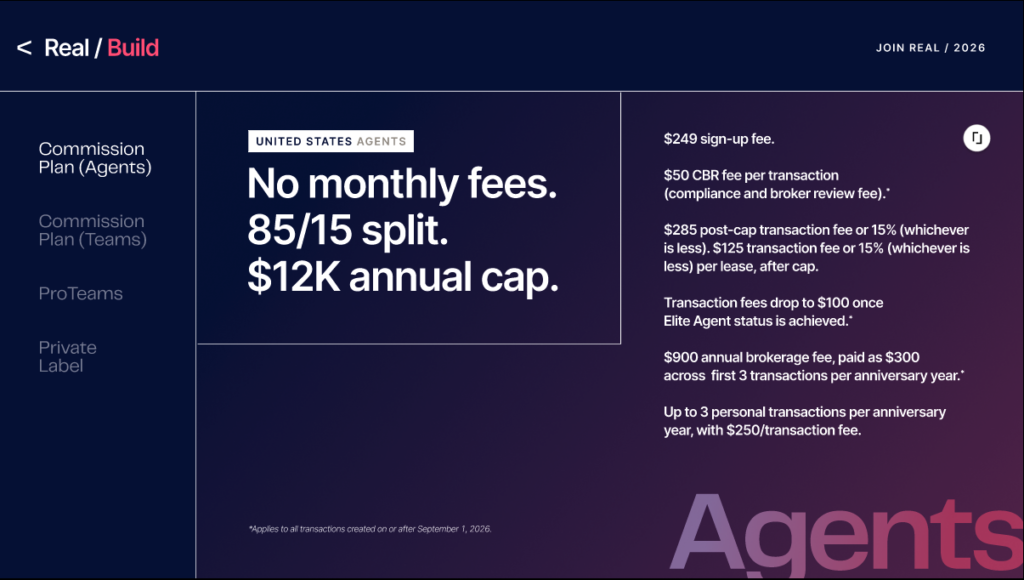
REAL’s commission structure is also very straightforward. Agents pay a 15% split until they reach the annual cap of $12,000; then they keep 100%. There’s also a $900 annual fee, but instead of paying it all at once, it’s spread across your first three transactions of the year: $300, $300, $300, making it much easier to budget for.
In addition to that, there’s a $50 compliance and broker review fee on each transaction. Until you cap, that is all the fees you pay. After you cap, your commission split goes away completely, and you’re simply paying a $285 post-cap transaction fee for each closing for the rest of your anniversary year, which drops to $100 per transaction after hitting Elite Agent.
Test out my REAL Broker Fee Calculator to see how much it would cost you to do business here.
For agents closing a healthy number of transactions every year, that can result in significant savings compared to brokerages with higher splits or ongoing royalty fees, monthly fees or no cap on their splits at all.
The Keller Williams office I came from had a $ 28,000-a-year cap plus a $ 3,000-a-year franchise fee and other smaller fees on top of that.
I personally saved close to $20,000 in my year here at REAL.
That was money I was able to reinvest in my business, in training and coaching, in video editors and virtual assistance.
I think it’s important to fully understand how much you are giving your brokerages each year and then ask yourself, am I getting that much value in return? Unfortunately, for many agents,the answer is no.
Con: REAL Requires Self-Motivation
One of the things many agents love about REAL is the freedom.
But it’s important to understand that freedom also comes with responsibility.
Nobody is checking to make sure you made your prospecting calls today. Nobody is requiring you to attend office meetings every Tuesday morning, and nobody is tracking whether you practiced scripts or attended role play this week.
REAL provides the platform, the technology, the training, and the support, but it’s ultimately your responsibility to build your business.
Some agents absolutely thrive in that environment because they already think like business owners. They enjoy setting their own schedule and holding themselves accountable.
Other agents find that much more challenging. Without structure, it’s easy to become distracted or simply put off the activities that actually generate business.
If you know you’re someone who benefits from accountability, that’s perfectly okay.
In that case, I’d strongly consider joining a productive team, hiring a real estate coach, or finding an accountability partner who helps keep you focused on your goals.
Pro: Award-Winning Technology

If there’s one area where I think REAL has separated itself from all other brokerages, it’s technology.
Almost every brokerage claims they have great technology, but in many cases, they’re simply paying for software from several different companies and trying to get everything working together.
REAL took a different approach. REAL has over 140 full-time developers building out their own platform and suite of tools. Where all the tools are built into the platform and work seamlessly with each other. No more having to log into 5 different websites to manage your business.
The center of that ecosystem is a platform called reZEN. This is where agents manage transactions, monitor commissions, track production, view business analytics, and access many of the resources they use throughout the day.
In reZEN, you can also access REAL Signature, which is our digital signature platform used to get contracts signed. Or our design center, which is fully integrated into your MLS and can pull your listings’ photos and details right into the designs, and has over 500 template designs specifically for real estate agents.
A huge focus of REAL lately has been their Leo AI, which I think is the most advanced AI in the real estate industry.
Right now, the primary use of Leo is for support. It’s been trained on all of REAL’s policies, trained on your own personal production, and even trained by your state’s broker on common issues and state resources so you can get initial broker-level support from Leo.
REAL’s vision, though, is to build out over 30 different AI tools within Leo that will actually do work for the agent and give every agent access to these completely for free.
For example, right Leo can actually nurture your real estate leads, send them properties, and even get them fully pre-approved. So you hand it cold leads, and it hands you back pre-approved buyers ready to look at a home.
REAL is also training Leo on how to actually write contracts for you. Right now, as it’s being trained, it can review your contracts and let you know of any missing signatures, blank fields or missing forms.
They are also coming out with a marketing companion that will create marketing material automatically for you for any new listing and allow you to edit, download, or print it.
REAL also has its mobile app, which allows you to access all of these features and manage your entire business from your phone.
On top of all of that, REAL partners with Lofty to provide agents with a powerful CRM and a custom website that’s optimized for lead generation and automation.
When you add all of these pieces together, technology starts acting almost like a virtual assistant for solo agents.
All of this is going to free up more of your time, so you can focus on what’s important, workings with clients.
Pro: Multiple Streams Of Income
Most agents run their business by chasing after one commission, then the next commission and the next soon.
There is no real long-term wealth building, no passive income, just commission.
REAL wanted to teach agents that there are many different ways to monetize the same business that you are already doing.
First off, REAL still rewards great production; in fact, most agents keep more of their commission here. But it also gives agents several opportunities to build additional income streams alongside their real estate business.
One of those opportunities is stock ownership.
REAL has five different ways agents can earn shares in the company for achieving different milestones in their businesses. One of the largest is the Elite Agent Award, where agents can earn a $12,000 Production Award, plus up to an $8,000 Cultural Award.
For many agents, they look at the stock awards are essentially a built-in retirement plan. If they have their business here for 10 years, they could be walking away with hundreds of thousands of dollars’ worth of stock they earned for free.
Another well-known program is Revenue Share.
When you introduce another agent to REAL, and they decide to join, you can earn up to $4,000 per year for each capping agent you attract. REAL also extends that opportunity through five tiers, so if the agent you bring in brings someone else in, you can earn on that agent as well, going down 5 levels.
Even just introducing a few agents to REAL can build significant passive income, which can help support you if you don’t have any closings that month. If you choose to focus on it, revenue share could even surpass how much you earn from commissions and become your main source of income, as it has for me.
When I first joined REAL, I was closing 30 deals a year. Now, 5 years later, I’m fully out of production and earning over $300,000 a year from revenue share as a solo agent. And that opportunity exists for every agent at the company.
REAL also offers the REAL Originate program.
Agents who obtain their mortgage loan originator license can earn additional income by helping connect their clients with One REAL Mortgage. By doing this, you earn a small commission for originating the loan in addition to your buyer agent commission.
The company also offers a joint venture with One REAL Title. This means you own a piece of your state’s title company and are paid part of the profits once a quarter.
And if coaching is something you enjoy, REAL’s mentorship program allows experienced agents to help newer agents while earning income for providing that guidance.
What I appreciate most isn’t necessarily any one of these programs individually. It’s that they give agents opportunities to build a more diversified business instead of relying exclusively on commissions year after year.
For many agents, having multiple potential income streams provides additional stability and opens doors that simply don’t exist at many traditional brokerages.
Con: Less Brand Recognition

One potential downside to joining REAL is that, while it’s one of the fastest-growing brokerages in North America, it still doesn’t have the same level of consumer brand recognition as companies like RE/MAX, Coldwell Banker, Century 21, or Keller Williams. Those brands have been around for decades, and many buyers and sellers have grown up seeing their signs in neighborhoods and their commercials on television.
You may occasionally find yourself explaining who REAL is or answering questions from clients who haven’t heard of the company before.
That said, I think the importance of brokerage branding has changed quite a bit over the last decade. More and more consumers are choosing their agent because of online reviews, social media, YouTube, referrals, or the relationship they’ve built with that individual agent—not because of the logo on the business card.
Personally, I think in 2026, your personal brand is far more important than your brokerage’s brand.
For me, I’ve always focused on social media and video, and by the time a new lead reaches out to me, they have watched hours of my content, gotten value from it, and already feel like they know me. They couldn’t care less what brokerage I was at because they are hiring me, not the brokerage.
Personally, I think this idea that clients would choose you based on what brokerage you work at is just a story that legacy brokerages tell agents to try to justify their high splits and fees.
And I think that as REAL continues to grow, its brand awareness is growing as well.
I also think the recent announcement of REAL acquiring REMAX certainly made waves in and out of our industry and caused many people to notice REAL for the first time.
Pro: Strong Training & Community

One thing I don’t think REAL gets nearly enough credit for is the amount of education that’s available to agents.
REAL Academy contains hundreds of on-demand training classes covering just about every topic you can imagine. Whether you’re trying to improve your listing presentations, learn YouTube marketing, build systems, or increase your production, we have online classes covering all of these and more.
On top of the on-demand content, REAL offers an incredible number of live training sessions every single week. There are usually twenty-five to thirty live classes, masterminds, workshops, or coaching sessions available to every single agent in the company.
What’s nice is that these aren’t all taught by the same person. You’re learning from top-producing agents, team leaders, coaches, and industry experts who are actively building successful businesses themselves.
One thing that REAL does differently from other companies is that everyone has access to everyone else’s classes and masterminds. There are no silos or exclusive training for one agent’s network but not others’.
For example, I teach a mastermind every other week all about YouTube, and it is available to all agents at REAL, whether they are in my network or not.
REAL also has its Agent BreakThru series, where they hire national coaches to come to REAL and teach 6-week courses completely for free. We recently had Phil Jones teach a 6-week course all about the language of sales. Before him, we had Jason Pantana teach a 6-week course all about AI and using it to streamline your business.
REAL also has many different in-person training events as well.
For example, their Further Together events. These are in person agent lead events where they have top producers come in to present, answer questions, and connect with agents. There are dozens of these throughout the country each year.
Then they have their Velocity events, which are put on by REAL and feature top producers as well as industry leaders, and are focused on the systems, standards and framework used by the top 1%.
Then they have their annual RISE event, which is 2 days of training, networking, and company announcements. At RISE, you get to select what masterminds and classes you want to attend to make sure every agent gets what they need out of it.
And REAL also has WorkVivo, which is a social media platform exclusively for agents at REAL. You can join groups, ask questions, and message any agent within REAL here.
To me, technology isn’t REAL’s only strength. I think we lead the industry when it comes to the culture, the collaboration, and the training which is available to every agent at the company.
Con: Your Sponsor Can Matter
One thing I don’t think gets talked about nearly enough is how much your sponsor can influence your experience during your first year at REAL.
Your sponsor isn’t your manager, and they aren’t your broker. But they can become an important resource as you’re learning the platform and figuring out how to get the most value from everything REAL offers.
A good sponsor understands how the brokerage works, knows where to find answers, and can point you toward the right training, tools, and resources instead of leaving you to figure everything out on your own.
One thing I really appreciate is that REAL has pretty strict rules around sponsorship. Agents are not allowed to promise things of value in exchange for naming them as your sponsor. So this means things like free courses or masterminds, etc., and I actually think that’s a good thing because it keeps the playing field fair and fosters a culture of collaboration.
That doesn’t mean that your sponsor does not matter.
A good sponsor is another level of support for you, especially as you are learning the systems. They should be someone you can call if you get lost or need help with REAL’s platform.
Your sponsor can also be a resource for you. Someone you can mastermind with about your business, learn from, and someone who can help you grow your own network of agents.
For newer agents, especially, your sponsor can have a big impact on your experience and your business success.
One feature that’s unique to REAL is that you can name either one sponsor or two co-sponsors when you join. I don’t think everyone needs to name 2 sponsors but I do I think more new agents should take advantage of this.
If you’re newer to the business, I highly recommend that at least one of your sponsors be in your local market. This way, you have someone who can help you write your first few contracts, someone familiar with your local MLS and who understands your market.
At the same time, your second sponsor might be someone who has built a business that’s similar to the one you’re trying to build, whether that’s YouTube, luxury real estate, teams, investing, or agent attraction.
The reality is that you’ll probably build relationships with dozens of agents at REAL over time. But your sponsor is often one of the very first people you get to know, so it’s worth taking a little extra time to choose someone who’s a good fit for you and your business goals.
Looking for a sponsor for into REAL?
You can browse my team of trained sponsors who have experience successfully transitioning other agents’ businesses to REAL here.